


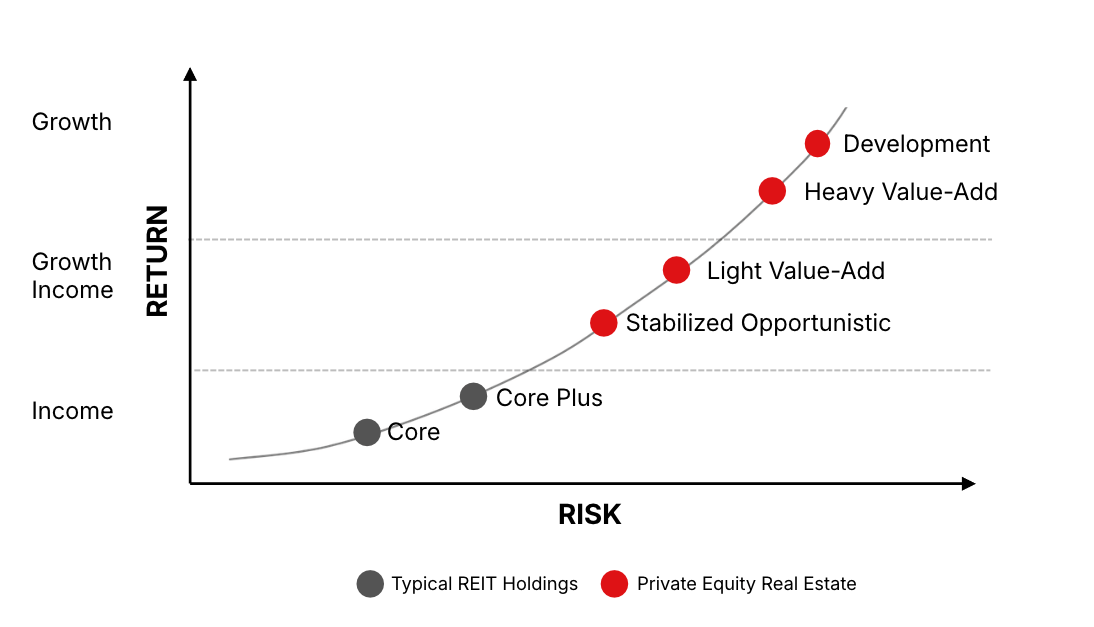
Commercial real estate investors have relied on core and core-plus strategies for decades as sources of income. Those approaches still earn a place in many portfolios. Investors focused on growth and capital appreciation, however, may want to look further along the risk curve, including ground-up development and redevelopment.
The backdrop for growth investing in 2026 is complicated. The Federal Reserve raised its benchmark rate in September for the first time since 2023, then held it at 3.75% to 4.00% in October.¹ Consumer prices rose 3.7% over the 12 months ending in September, with energy up 20.4%.² Public markets remain volatile. Many investors, and the financial professionals who advise them, are turning to private real estate to help pursue expected returns. Development and redevelopment (ground-up construction or converting a property to a new use) may help meet that need, because an experienced developer may be able to create value that does not depend on the broader market.
Return Objectives Determine Appropriate Strategy
Commercial Real Estate Investment Risk Return Profiles³
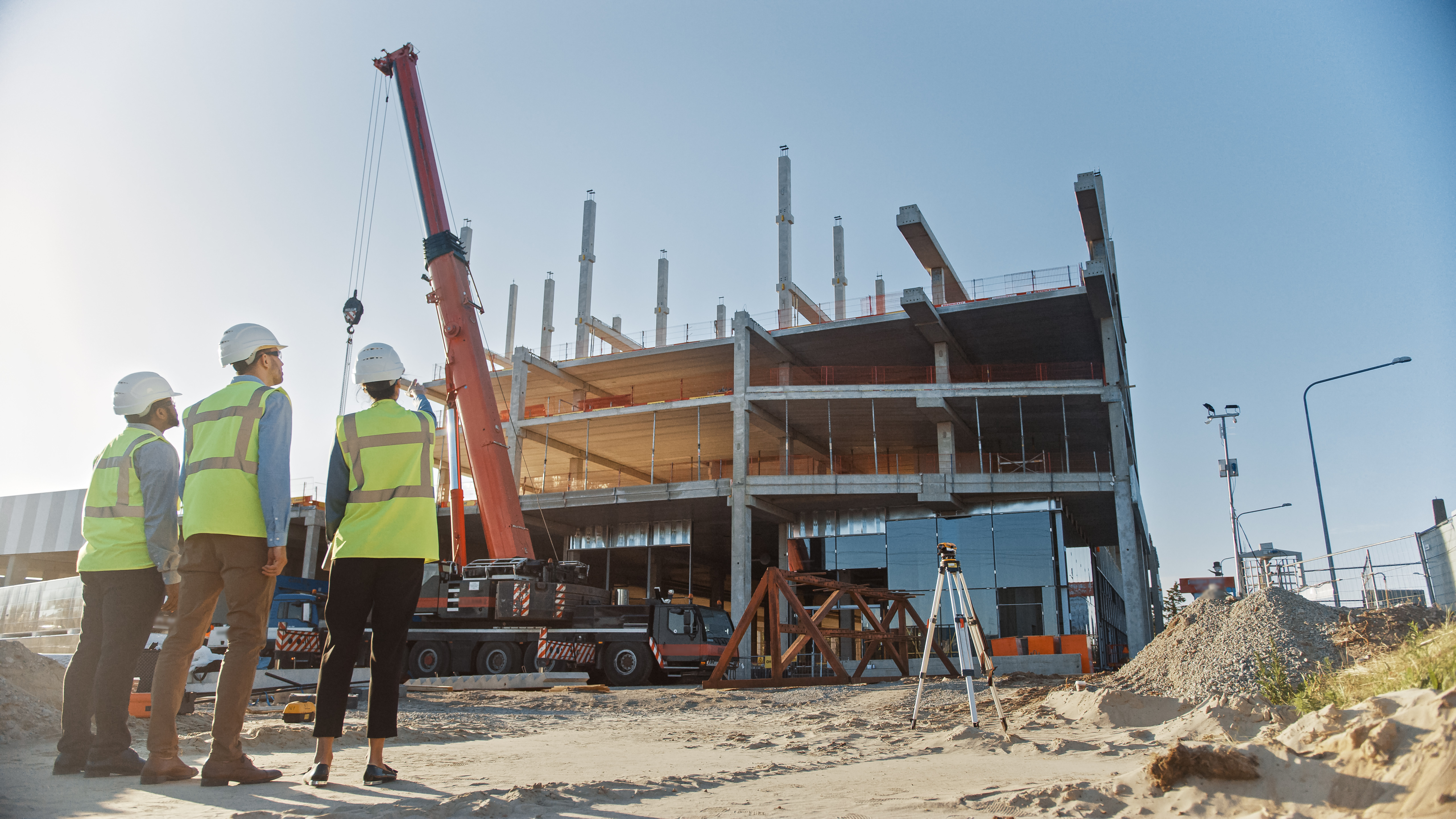
Development Real Estate
Development may offer higher return potential than stabilized real estate. It also carries more risk because the building does not yet exist or generate income. Investor sentiment has turned cautious since 2023. CBRE's 2026 North American Investor Intentions Survey found that just under two-thirds of investors prefer value-add and core-plus strategies, and interest in opportunistic strategies declined from the prior year.⁴
That caution shows up in new construction. U.S. multifamily starts fell to roughly 55,000 units in the first quarter of 2026, the lowest quarterly total since 2011 and about 73% below the early 2022 peak.⁵ Projects typically take two to three years to deliver, so fewer starts today may mean fewer buildings competing for tenants when projects open.
Create Growth Through Cap Rate Compression
The capitalization rate, or cap rate, is a property's net operating income (NOI) divided by its value or sale price. Investors generally want to buy at a higher cap rate and sell at a lower one. A lower cap rate means the same income supports a higher value.
Rising interest rates tend to push cap rates the other way, or at least freeze the market. Buyers need lower prices to make the math work with higher borrowing costs. Sellers are reluctant to accept them, and transaction volume slows while each side waits for the other to move.
Development may offer a way to create value without waiting for the market to compress cap rates. A developer aims to build at a cost that produces a higher yield than the market cap rate for a comparable finished property. The gap between the two, often called the development spread, is where value is created. The hypothetical example below shows how it works. ⁶
Hypothetical Example*
| Capital | Amount |
| Developer capital | $1,000,000 |
| Investor capital | $2,500,000 |
| Borrowed capital | $6,500,000 |
| Total project cost | $10,000,000 |
| Operations | Amount |
| Total Units | 100 |
| Average annual rent per unit | $9,000 |
| Stabilized annual NOI | $900,000 |
| Exit | Amount |
| Stabilized cap rate | 9% |
| Sale price | $12,500,000 |
| Exit cap | 7% |
| *Hypothetical example included for illustrative purposes only. Results depicted in this example are based on various assumptions, which may prove to be incorrect. Actual results may vary materially from those depicted above. | |
The project in this example costs $10 million and produces $900,000 of annual NOI once stabilized, a 9% cap rate on cost. A sale at a 7% exit cap rate supports a sale price of $12.5 million. The developer has, in effect, created its own cap rate compression without relying on the market to deliver it.
Opportunities with Distressed Assets
Don't let the term "distressed" create the wrong picture. In redevelopment, the building is often sound. The distress is usually financial and belongs to the owner, such as a maturing loan, rising costs, or a vacancy problem that forces a sale at a discount. That creates an opportunity for an experienced real estate firm with a strong balance sheet to buy the property at an attractive price and reposition it for the use the market needs.
Other Considerations
Development is not for every investor. Projects take years to complete and require a developer with deep experience in every phase, from entitlements through lease-up.
Phases of Development
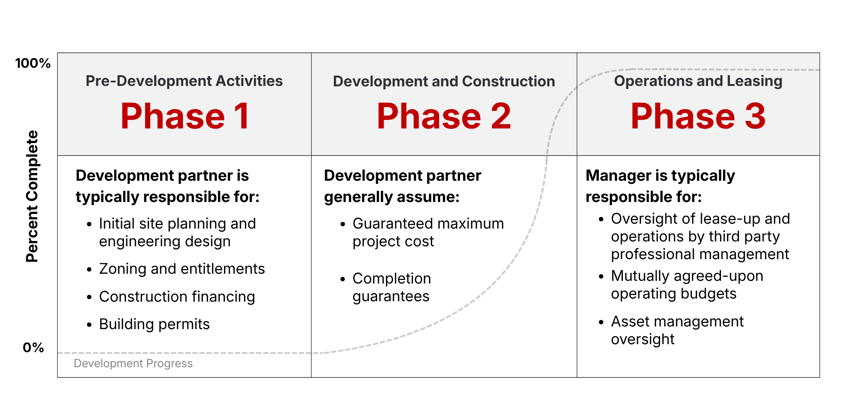
The phase at which an investor enters a project shapes its risk and return profile. Phase 1 is predevelopment, when work such as zoning and entitlements is still underway. Investors who enter during Phase 1 take on more uncertainty about timing. They may also have greater return potential because they participate in more of the value a project can create.
Phase 2 begins once a project is shovel-ready. Many of the variables that affect timing are largely resolved by then, so investors who enter during Phase 2 typically have a shorter time horizon. The right entry point depends on an investor’s goals, time horizon, and tolerance for risk.
A well-structured development or redevelopment strategy may give investors an option beyond stocks and bonds, especially with rates rising again and inflation running above the Fed's target. Investors weighing these strategies may benefit from talking with a financial professional about how they work and what can go wrong.
Frequently Asked Questions
What is cap rate compression? Cap rate compression is a decline in the capitalization rate the market applies to a property's net operating income. Value equals NOI divided by the cap rate, so a lower cap rate means a higher value for the same income.
What is yield on cost in real estate development? Yield on cost is a development project's stabilized net operating income divided by its total project cost. Developers compare it with market cap rates to estimate how much value a project may create.
Why does the entry phase matter in a development investment? The entry phase shapes a development investment’s risk and return profile. Investors who enter before zoning and permits are secured take on more uncertainty about timing and may have greater return potential. Investors who enter once a project is shovel-ready typically have a shorter time horizon.
Important Note: Developments involve risk, including construction, financing, lease-up, and market risks. Market indicators and rankings should be considered alongside project-specific underwriting and due diligence.
Sources:
1. Board of Governors of the Federal Reserve System, "Federal Reserve issues FOMC statement," September 16, 2026, and October 28, 2026.
2. U.S. Bureau of Labor Statistics, "Consumer Price Index – September 2026," released October 14, 2026.
3. This chart is a generic representation of a return vs. risk comparison. There can be no assurance that return objectives for a development project will be achieved. Actual returns in any development project will depend on the ability of the developer to develop the property in accordance with the approved development budget and within the approved development schedule, which are subject to conditions beyond the control of the subject fund.
4. CBRE Research, "2026 North American Investor Intentions Survey," January 29, 2026.
5. Apartments.com and CoStar, "Apartments.com and CoStar Release a Multifamily Construction Activity Update for Q1 2026," press release, May 12, 2026.
6. This hypothetical example is for illustrative purposes only and does not represent any actual investment or Inland program. It does not reflect all transaction costs, fees, or taxes, which would reduce results. There can be no assurance that any development project will achieve its projected costs, income, or value.