
Self-Storage Sector

Self-storage facilities provide individuals or businesses with secure, rentable space to store personal belongings, inventory, or equipment. These units are typically housed within a larger facility and come in various sizes, allowing renters to flexibly access items in storage.

New! 2025 Self-Storage Sector Review

Self-Storage

Inflation Hedge

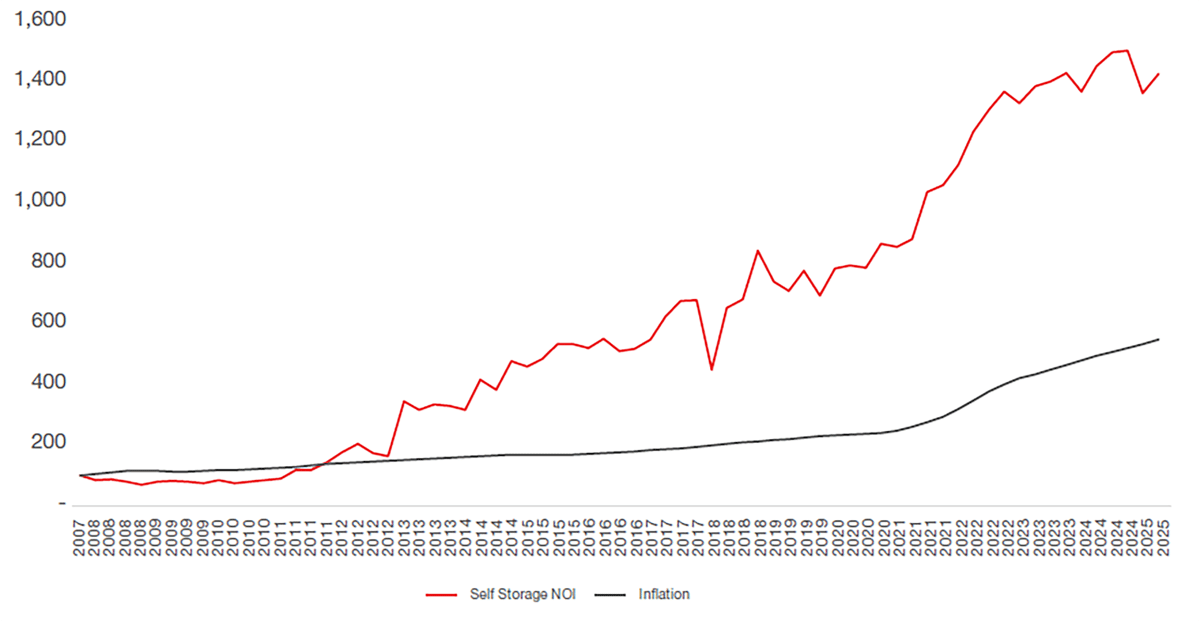
Real estate’s ability to hedge inflation depends largely on whether the asset's income can outpace the inflation rate. Self-storage is uniquely positioned in this regard. With monthly leases, operators can adjust rents frequently—offering a potential advantage over real estate assets with long-term lease structures. 

This is reflected by self-storage properties having delivered an average annual net operating income (NOI) growth of 4.4% since 2010, compared to inflation over the same time of 2.5%. Between 2008 and 2024, income growth in the self-storage sector outpaced inflation by 190 basis points—underscoring self-storage’s potential to deliver strong, sustained returns in a shifting economic landscape.1

Self-Storage NOI Compared to Inflation1
SS Inflation - Image copy

Data as of October 2025

2 NCREIF Expanded NPI Rent Growth & FRED CPIAUCSL.

Demographic-Driven Demand

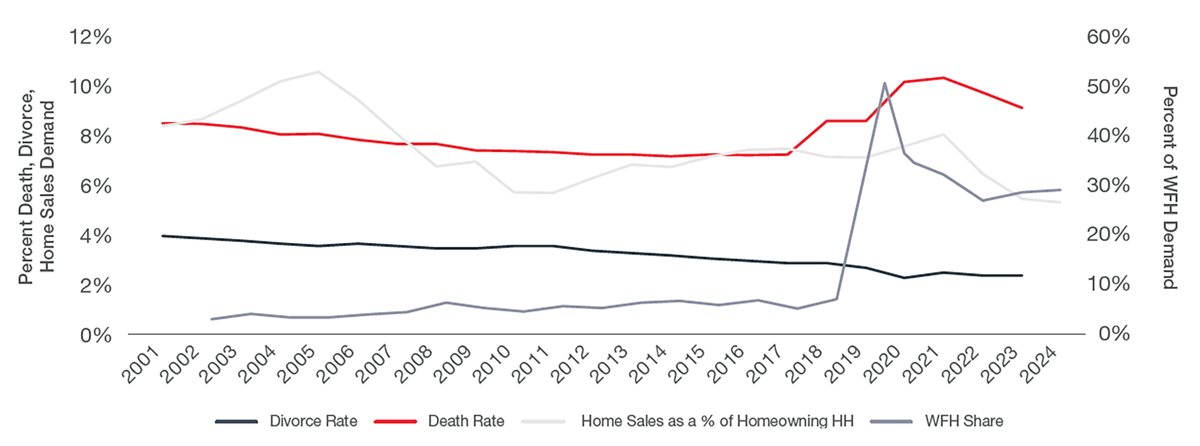
Self-storage has been a top-performing asset class for nearly two decades, driven by its unique operating models and resilient demand characteristics - typically referred to as the "Four Ds - death, divorce, downsizing, and displacement."

Self-storage demand drivers stem from age-related life events that impact household living situations. From household formation to job changes to upsizing and downsizing, these scenarios often prompt the need for temporary or long-term storage of goods.

The Four Ds2
 

SS Four Ds - Image copy

Death: As the U.S. population ages, the number of annual deaths is steadily rising—from 2.4 million in 2000 to 3.0 million in 2024, with projections reaching 4.2 million by 2050.3 This trend often drives demand for self-storage, as families seek space to manage and preserve inherited belongings.
 
Divorce: Nearly 40–50% of first marriages end in divorce, with the median marriage lasting eight years.4 Given that the average age of first marriage is now around 305 and the peak millennial age is 32–34, a wave of seasoned marriages may lead to increased divorces. This shift can create demand for self-storage as individuals form smaller households and require additional space.
 
Downsizing: Baby boomer births peaked in 1957 at approximately 4.3 million.6 As this cohort enters retirement, many are downsizing to reduce housing costs and simplify living. While smaller homes solve space and financial concerns, they often create a need for off-site storage to house decades of accumulated belongings.
 
Dislocation: Dislocation—defined in the self-storage context as anything prompting a move—includes job changes, relocations, work from home environments, and new household formations. With ongoing migration to Sunbelt states and millennials forming households at scale, these life transitions continue to fuel demand for flexible, accessible self-storage solutions.
 
Data as of October 2025
 
2 FRED, NAR, CDC.gov, wfhresearch.com
3 Population Deaths in United States of America (1950-2025 & Future Projections)
4 Modern Family Law. Top 10 Divorce Statistics You Need To Know. May 2025.
5 U.S. Census Bureau. Median age at first marriage. 1890 to present.
6 U.S. Census Bureau.

Self-Storage Education & Insights

Self Storage
This self-storage sector update discusses the key factors that we believe position the sector well for a potential return to...
Self Storage
Inland Private Capital Corporation’s EVP & Chief Investment Officer, Rahul Sehgal, gives insight into the factors that are...
Alternative Sectors
This in-depth guide offers an overview on three growing, recession-resilient real estate sectors whose performance is driven by...

Who You Invest with Is Everything®

We can help investors connect with a financial professional who can tailor strategies to individual goals, assess suitability, and provide expert guidance throughout the investment process. We encourage financial professionals interested in learning more to connect with us—we’re here to support your clients and your business.