
Real Estate Investment Trusts: An Open End Investment Solution
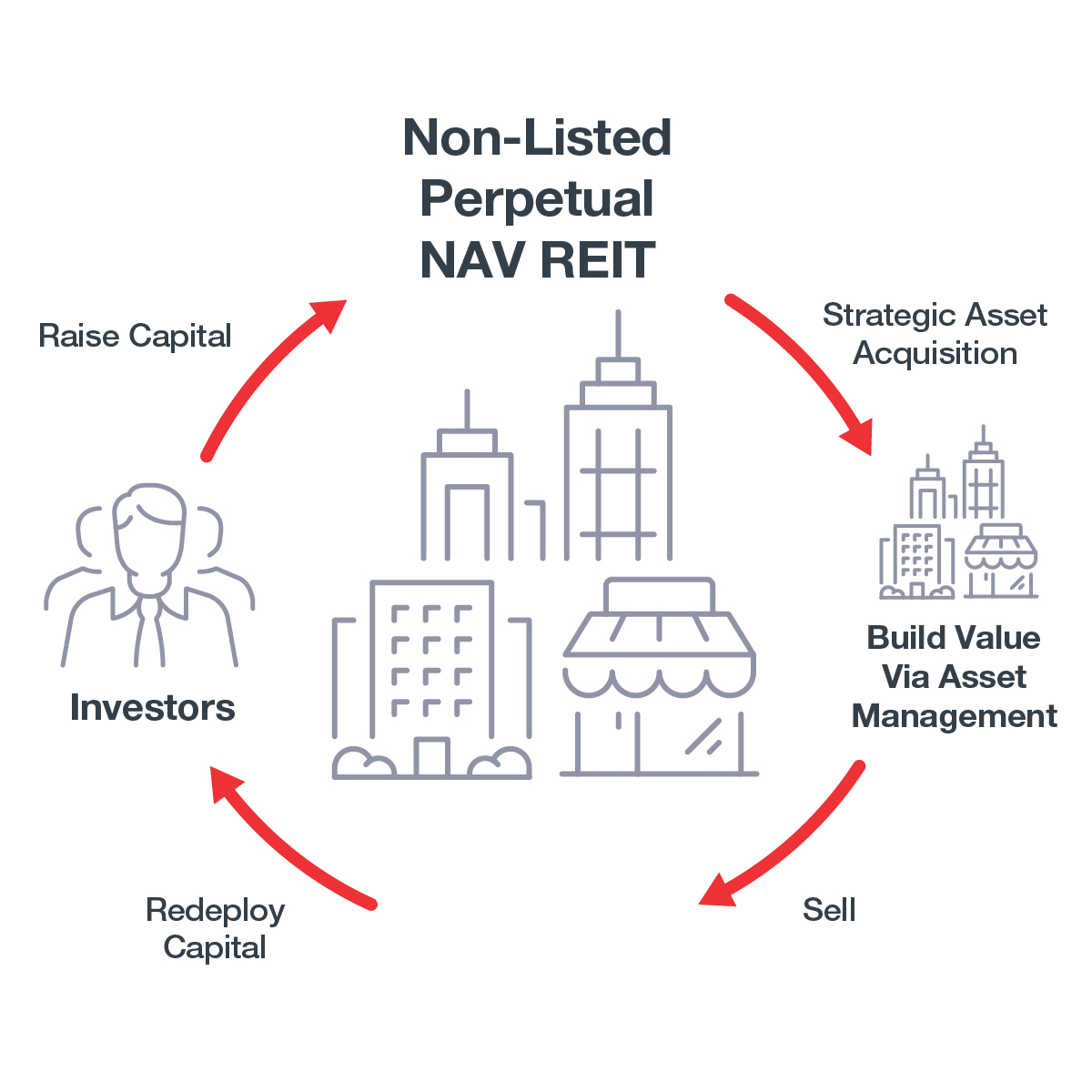
Real estate investment trusts (REITs) strive to achieve a balance between ongoing cash flow and property appreciation. REITs pool capital from multiple investors to acquire and manage income-generating commercial properties, making large-scale real estate easier to access while diversifying investment portfolios.
Non-Correlated Solutions for Investment Portfolios
- Private real estate has historically demonstrated low correlation with publicly traded equities and fixed-income securities.
- Incorporating non-correlated, low or negatively correlated assets can mitigate overall portfolio risk, particularly during periods of market volatility.
- Non-correlated investments exhibit limited alignment with broader equity market movements, contributing to enhanced portfolio stability.
- Allocating to private real estate within a diversified investment portfolio can help balance risk exposure and reinforce structural stability.
|
Private Real Estate |
Public Real Estate |
S&P 500 |
Investment Grade Bonds |
Municipal Bonds |
|
|---|---|---|---|---|---|
|
|
1.0 | ||||
|
|
0.2 | 1.0 | |||
|
|
(0.0) | 0.6 | 1.0 | ||
|
|
(0.1) | 0.3 | (0.0) | 1.0 | |
|
|
(0.2) | 0.5 | 0.2 | 0.8 | 1.0 |
REITs: A Foundation of Trust
A REIT is a company that owns, operates, or finances a portfolio of real estate properties. Subject to certain suitability standards, any investor can purchase shares of a REIT. Shares of a REIT can allow individual investors to indirectly own professionally managed, income-producing properties, typically earning a share of the income produced by the portfolio of properties through distributions or dividends.
Potential Benefits of REIT Allocations
There are approximately 170 million Americans invested in REITs through retirement savings plans and other investment funds with REITs owning more than 580,000 real estate assets across the U.S.1
1 https://www.reit.com/
Inflation Hedge
Acquiring income-producing properties with the potential to increase rents gives investors a unique opportunity to keep up with inflation and participate in potential capital appreciation.
Tax Advantages
Structured as pass-through entities, REITs eliminate “double taxation” (taxation at both the corporate and stockholder level) if it distributes at least 90% of taxable income to its stockholders each year.
Diversification
REIT can be diversified by property type, location, tenant and/or lease term which can help smooth portfolio risk.
Passive Investing
REIT investors own interests in income-producing properties without the burden of management responsibilities.
Transparency
REITs Offer Tax Relief
Investing in REITs not only offers exposure to income-generating real estate, but it also comes with a range of tax advantages that can enhance overall returns.

As long as a REIT distributes at least 90% of its taxable income to shareholders, it qualifies as a pass-through entity and avoids paying federal corporate income tax on those earnings. Some states also exempt REITs from state-level corporate taxes.

Because REITs do not pay taxes on the income they distribute, more income goes directly to shareholders in the form of dividends. This can maximize the amount of income investors receive compared to traditional corporations, where profits are taxed at both the corporate and individual levels.

Investors may also benefit from tax deductions like the Qualified Business Income (QBI) deduction, which allows up to 20% of REIT dividends to be deducted from taxable income, further reducing the effective tax rate.
The Power of Preferential Tax Treatment in REIT Investments
This informative piece explains how REIT investors may receive preferential tax treatment on income distributions and includes a hypothetical example of how REITs compare to other investment vehicles on an after-tax yield basis.
Who You Invest with Is Everything®
We can help investors connect with a financial professional who can tailor strategies to individual goals, assess suitability, and provide expert guidance throughout the investment process. We encourage financial professionals interested in learning more to connect with us—we’re here to support your clients and your business.