


Successful multifamily development begins with disciplined market selection and experienced execution.
A compelling building and a growing city are not enough on their own. Long-term success depends on the right project in the right location, with the right team at the right time. Multifamily development can offer attractive growth potential, and these five keys give anyone evaluating a multifamily opportunity a practical way to separate a well-supported project from one that only looks good on paper.
1. Start With an Experienced Development Team
Real estate development is complex. Entitlements, financing, construction, leasing, and operations each introduce risk well before a property is fully leased and generating income.
An experienced developer should have a strong record of selecting sites, navigating local approvals, managing construction, controlling budgets, and delivering a property that appeals to its intended renter. That experience matters most when financing costs are on the rise, construction runs into problems, or lease-up takes longer than expected.
Key question. Has the developer managed the full development cycle, including periods when market conditions changed?
2. Select a Location with Durable Demand Drivers
A desirable location offers more than proximity to restaurants, shops, and transit. The more important question is what will keep bringing renters to the area.
Major employers, universities, healthcare systems, corporate relocations, and transportation infrastructure can all support renter demand. Markets with several demand sources may be better positioned than those that depend on one employer or a short-term migration trend. Size matters less than it seems. Smaller markets can offer compelling fundamentals when limited new supply meets a durable economic engine.
Key question. Why are renters choosing this market today, and what is likely to support demand tomorrow?
3. Follow Employment Growth and Rent-Supporting Incomes
Employment growth is one of the clearest signals of future renter demand. New jobs bring new households to the market, and many of them start out renting.
Anyone evaluating a project should look at the types of jobs being created, where they are located, and whether those incomes can support the project’s planned rents. Durable job creation that matches the project’s renter profile and price point tells a stronger story than fast growth alone.
Key question. Do local jobs and household incomes support the rents the project’s financial projections assume?
4. Balance Demand Against Current and Future Supply
Strong demand is only one side of the equation. Even a growing metro can struggle if many competing apartments deliver at the same time.
A project’s financial analysis, often called underwriting, should weigh existing inventory, occupancy, units under construction, and the planned pipeline. Some construction in a market is normal and healthy. What matters is whether expected renter demand can absorb both existing and new supply.
RentCafe’s Rental Competitiveness Index (RCI) adds useful context. It combines renter competition, lease renewals, vacancy duration, occupancy, and the share of newly built apartments into one score. Chicago led all large markets in RentCafe’s peak-season 2026 analysis with a score of 91.8, about 17 prospective renters for each available apartment, and an average of 27 days to fill a vacancy. The national score was 73.9, with about nine renters per available unit.1
Key question. Can projected demand absorb existing inventory, active construction, and the planned pipeline?
5. Make Sure the Project Can Compete
A strong market cannot make up for the wrong project. The development must deliver the units renters want, at rent prices that compete with comparable properties.
Underwriting should compare competing properties at the unit level, including rents, size, concessions, amenities, occupancy, and recently delivered communities. It should answer two separate questions. Is there enough demand for another multifamily property in this location? Can this particular property win its share of that demand?
Key question. Does the project offer the right units, amenities, and rents for its target renter?
Putting the Five Keys Together
No single statistic identifies a successful multifamily development. Population growth without jobs may not be enough, and job growth paired with heavy construction can create near-term pressure. A high competitiveness score signals strong demand today, but investors still need to understand future supply, achievable rents, and the team doing the work.
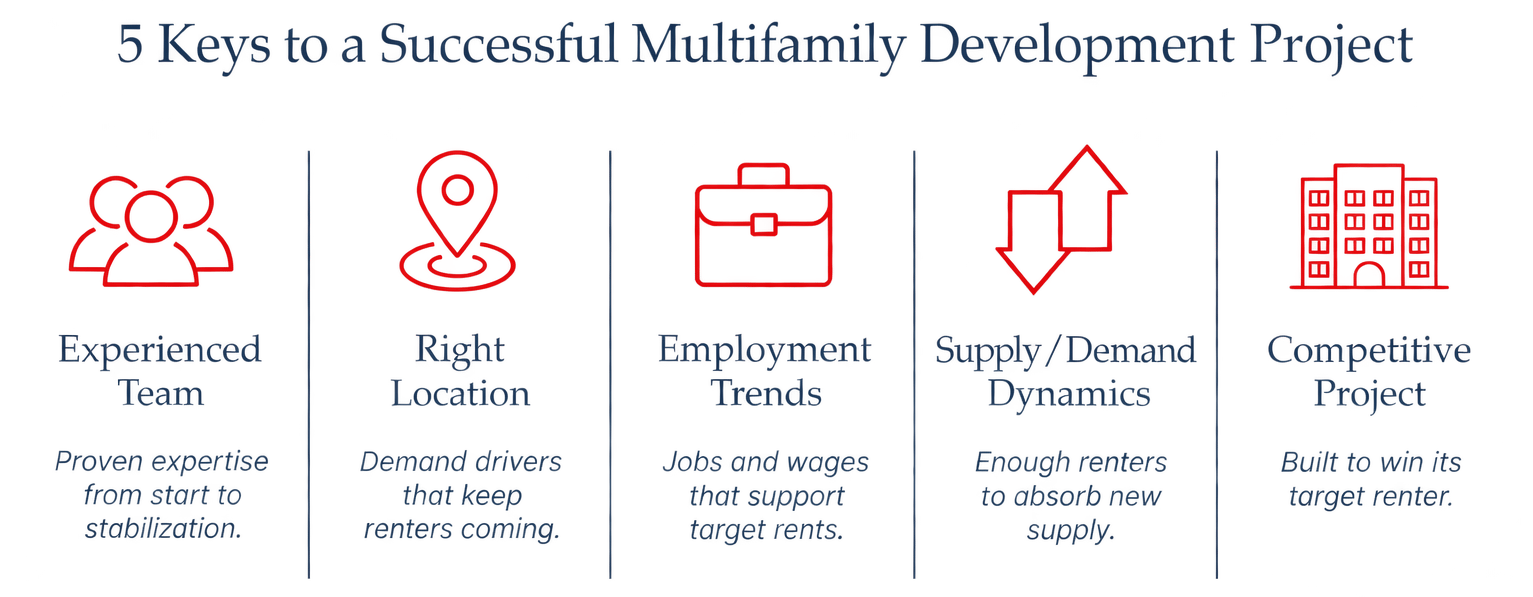 A development with all five keys in place has a stronger foundation for creating value. Investors may only see the finished building, but the team, the market, and the project’s competitive position are what make it work.
Important Note: Multifamily developments involve risk, including construction, financing, lease-up, and market risks. Market indicators and rankings should be considered alongside project-specific underwriting and due diligence.
Sources:
1. RentCafe, "Move over, Miami: Chicago is America's hottest rental market this peak season,” October 8, 2026
2. Mayo Clinic, "Mayo Clinic Board of Trustees approves plans to transform healthcare, improve experience for staff and patients, redesign Rochester campus," November 28, 2023.