
REIT Investments Offer Compelling After-Tax Distributions

Real estate investment trusts (REITs) may generate distributions and may offer portfolio diversification, regular cash flow, capital appreciation, and long-term wealth planning strategies for investors seeking portfolio stability during turbulent economic environments.1
Investing in real estate through a REIT can provide many of the benefits of direct property ownership without the responsibility of managing properties. REITs are generally not subject to entity-level income taxes on REIT taxable income distributed to the shareholders (i.e., effectively avoiding the “double-taxation” experienced by non-REIT corporations at the corporate and individual shareholder levels). REIT distributions are taxed at different rates depending on whether they are characterized as ordinary income, capital gains or return of capital (“ROC”). REIT distributions that are in excess of earnings and profits and do not exceed the adjusted basis of the investor’s stock are generally treated as non-taxable ROC.2
Return of Capital (ROC)
Due to real estate-related tax deductions such as depreciation and amortization, REITs are able to characterize a portion of distributions that would otherwise be ordinary income as return of capital (ROC). ROC distributions are tax deferred until redemption, at which time they give rise to capital gains. For example, a REIT may have 0% to 100% of their distributions characterized as ROC.
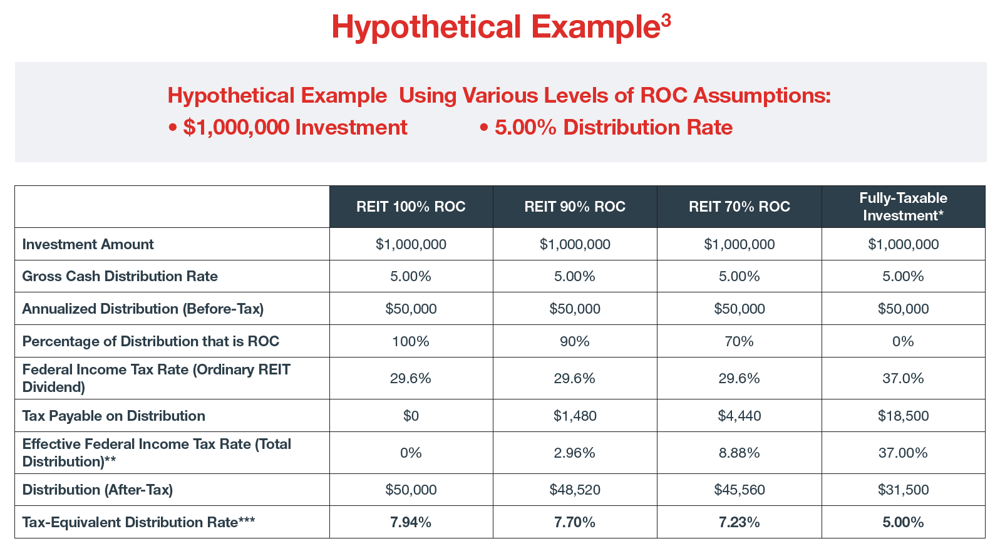
NOTE: Investors may also be subject to net investment income taxes of 3.8% and/or state income tax in their state of residence, which would lower the after-tax distribution rate received by the investor. Not shown in the hypothetical example above.
*At ordinary federal income tax rate of 37%, no 20% tax rate deduction, and not classified as ROC.
**Rate is reflective of the current tax year and does not take into account other taxes that may be owed on an investment in a REIT when the investor redeems his or her shares. Upon redemption, the investor may be subject to higher capital gains taxes as a result of a lower cost basis due to the return of capital distributions.
***Tax-equivalent distribution rate assumes that the investment in REIT shares is not sold or redeemed and reflects the pre-tax distribution rate an investor would need to receive from a theoretical investment to match the stated after-tax distribution rate earned by a REIT stockholder, if the distributions from the theoretical investment (i) were classified as ordinary income subject to tax at the top marginal tax rate of 37%, (ii) did not benefit from the 20% tax rate deduction and (iii) were not classified as ROC. The ordinary income tax rate could change in the future.
Additional REIT Considerations
A REIT is a company that owns, operates, and/or finances a portfolio of income-generating real estate and meets REIT requirements. Subject to certain suitability standards, REIT investors indirectly own part of the REIT’s professionally managed real estate portfolio.
-
Tax Deferral: REITs may engage in 1031 exchanges to defer recognition of taxable capital gains. Generally, the sale of real property triggers a tax obligation on any gain realized at the time of sale. Section 1031 of the Internal Revenue Code of 1986, as amended, provides an exception for real property held for productive use in a business or for investment and allows a taxpayer to postpone paying tax on the gain if such taxpayer reinvests the proceeds in similar property as part of a qualifying like-kind exchange.
-
Efficient Tax Reporting: U.S. Investors receive IRS Form 1099-DIV instead of K-1.
-
Unrelated Business Taxable Income (UBTI): A REIT is generally an effective UBTI blocker for tax-exempt investors. For U.S. tax exempts, no UBTI is expected provided such investors do not debt finance their investment nor exceed limits for pension-held REIT rules.
-
Capital gains treatment: If a portion of a REIT’s distributions comes from long-term capital gains, they are taxed at lower rates than ordinary income. REITs can also defer capital gains taxes by executing certain tax-deferred investment strategies, such as a Section 1031 exchange.
-
Estate Tax Planning: When REIT shares are inherited, heirs generally receive a tax-free step-up in basis equal to the prevailing fair market value at the time of transfer. Eligibility for this benefit is dependent on the investor’s specific facts and circumstances. This information does not constitute tax advice, and should not be relied upon by, potential investors, who should consult their own tax advisors.
Understanding a REIT’s tax treatment is particularly important for investors seeking an attractive long-term investment strategy.
IMPORTANT INFORMATION: This paper describes the tax considerations for U.S. Individual Investors only. Non-U.S. investors are subject to additional tax considerations not discussed herein.
REIT Investments Offer CompellingAfter-Tax Distributions
Education & Resources
1 The value of underlying REIT assets will fluctuate and may be worth less than the real estate program initially paid, and the investor may not be able to sell the investment.
2 REIT distributions cannot be guaranteed, may be modified at management’s discretion, and may be paid from sources other than cash flow from operations, including borrowing and net offering proceeds.
3 The hypothetical example and any accompanying communications have been prepared for informational purposes only, and are not intended, and should not be construed, as tax, accounting or legal advice to any potential investor. All prospective investors are strongly encouraged to consult with and rely on their own tax, legal, accounting, financial or other professionals. This model contains several assumptions about future events of a hypothetical real estate investment trust. These assumptions are arbitrary and do not correspond to any specific real estate investment trust.
Any forward-looking statements are based on information currently available to us and are subject to a number of known and unknown risks, uncertainties and factors which may cause actual results,
performance or achievements to be materially different from any future results, performance or achievements expressed or implied by these forward-looking statements.
Important Risk Factors to Consider
Investments in real estate assets are subject to varying degrees of risk and are relatively illiquid. Several factors may adversely affect the financial condition, operating results and value of real estate assets. These factors include, but are not limited to:
• changes in national, regional and local economic conditions, such as inflation and interest rate fluctuations;
• local property supply and demand conditions;
• ability to collect rent from tenants;
• vacancies or ability to lease on favorable terms;
• increases in operating costs, including insurance premiums, utilities and real estate taxes;
• federal, state or local laws and regulations;
• changing market demographics;
• changes in availability and costs of financing;
• acts of nature, such as hurricanes, earthquakes, tornadoes or floods
• economic risks associated with a fluctuating U.S. and world economy, including those resulting from the novel coronavirus and resulting pandemic.
The Inland name and logo are registered trademarks being used under license. This material has been prepared by Inland Real Estate Investment Corporation (Inland Investments) and distributed by Inland Securities Corporation, member FINRA/SIPC, dealer manager and placement agent for programs sponsored by Inland Investments and its affiliates. Publication Date: 10/9/2026