
Download our Insights

Defer & Diversify with a 721 Exchange/UPREIT Transaction

Investors looking for ways to defer capital gains tax while diversifying their portfolio may turn to an Internal Revenue Code Section 721 exchange tax mitigation strategy. 

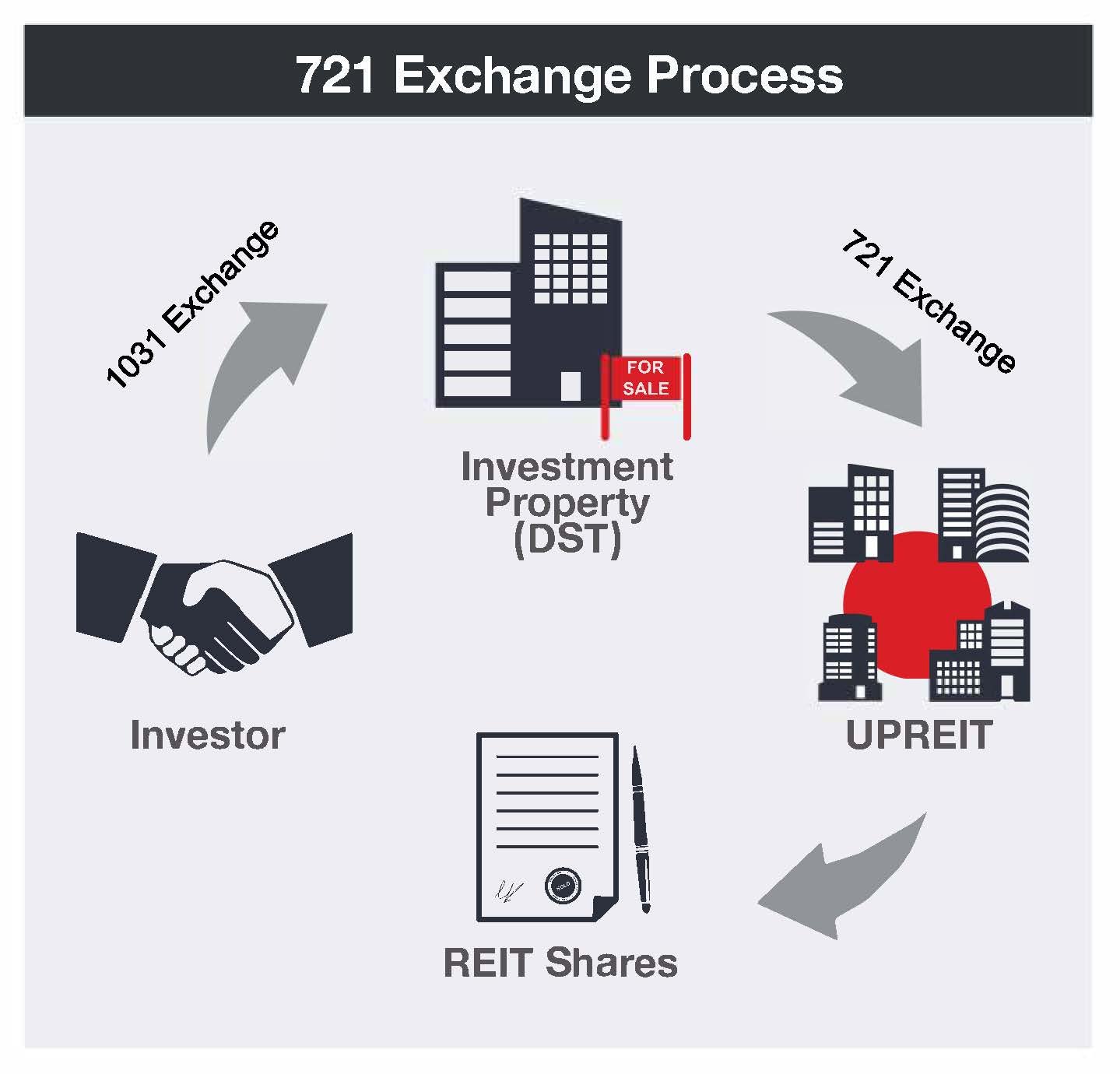
Property owners looking to sell real estate while deferring payment of capital gains tax can do so by completing a 721 exchange. Similar to a 1031 exchange in which property owners can defer capital gains tax on the sale of a business or investment real property, a 721 exchange transaction allows property owners to contribute real property in exchange for interests in an operating partnership of a real estate investment trust (REIT), that is structured as an umbrella partnership real estate investment trust, or UPREIT. Generally, a sale of property directly to a REIT is a taxable transaction to the selling property owner. In an UPREIT structure, a seller of a property who desires to defer taxable gain on the sale of its property may transfer the property to the UPREIT in exchange for limited partnership units (sometimes referred to herein as OP Units) in the partnership and defer taxation of gain until the seller later exchanges its OP Units on a one-for-one basis for REIT shares or for cash pursuant to the terms of the limited partnership agreement.

Property owners can contribute DST interests to an UPREIT in exchange for OP Units as part of a 721 exchange transaction. Taxes on this transaction are deferred as long as the OP Units are held, typically 12 to 24 months, and investors may receive distributions* during this period. Once the OP Units are redeemed for REIT shares, they may be able to be sold through a share repurchase program or on the open market.* However, such a sale would create a taxable gain.

It is important to note that shares of REIT stock do not qualify as like-kind property. If a stockholder sells the shares of the REIT, or the REIT sells a portion of the portfolio and returns capital to its stockholders, stockholders will be required to recognize any capital gain or loss when taxes are filed. Therefore, it is the end of the 1031 exchange capital gains deferral.
Inland-Insights-721-Exchanges-UPREITS-1-Oct-24-2025-06-41-56-4923-PM

Potential Benefits of a 721 Exchange

The 721 exchange is a sophisticated investment structure that is attractive for many investors for the following reasons:

icon_moneypie
Diversification

By transferring a single property to an UPREIT in exchange for OP Units in an operating partnership, the seller of the property may gain access to indirect ownership of a larger portfolio of properties.

icon_bar_chart_rise
Liquidity

In an UPREIT structure, owners of OP Units may be able to convert their units for shares of common stock of the REIT, which may provide access to liquidity options. However, the conversion may be a taxable transaction and in such event may cause the holder of the OP Units to recognize tax liability at the time of such conversion.

icon_time_money
Estate planning

OP Units can be split equally and either held or liquidated by the holder’s heirs or estate, receiving a step-up in basis, paying no capital gains and depreciation recapture taxes.

icon_moneybag
Hands-off investing

By transferring a property to an UPREIT in exchange for OP Units in an operating partnership, the seller of the property no longer will have to worry about property management responsibilities.

It is important to note that shares of REIT stock do not qualify as like-kind property. If a stockholder sells the shares of the REIT, or the REIT sells a portion of the portfolio and returns capital to its stockholders, stockholders will be required to recognize any capital gain or loss when taxes are filed. Therefore, it is the end of the 1031 exchange capital gains deferral.

A Section 721 exchange allows owners of real estate to contribute their property, on a tax-free basis, in exchange an economic interest in a portfolio of properties owned by an operating partnership, which interest will ultimately be redeemable for shares of the REIT itself. Although this transaction is a powerful tax deferral and diversification strategy for real estate owners to consider, it is complex and may  not be suitable for all investors.

Your Primer on the Tax-Advantaged 721 Exchange

Exchange property, defer taxes, and gain liquidity. Our Inland Insights explains how a 721 exchange works and highlights several potential benefits of this strategy.

If you own an investment property and are interested in exchanging it for a more passive investment that provides liquidity, this report is for you.

Education & Resources

QOZs
Hear from Inland Leadership and Baker McKenzie on the next generation of Qualified Opportunity Zones.
Capital Markets
In this report, Phil McAlister, Head of Research, explores the key trends influencing commercial real estate in 2026 and what...
Commercial Real Estate
Phil McAlister, Head of Research, explores the key trends influencing commercial real estate in 2026 and what investors should...

*Distributions or a return of capital are not guaranteed. Participants should not assume they will be able to resell their interests.

This is neither an offer to sell nor a solicitation of an offer to buy any security, which can be made only by an offering memorandum or prospectus that has been filed or registered with appropriate state and federal regulatory agencies and sold only by broker dealers and registered investment advisors authorized to do so. An offering is made only by means of the offering memorandum or prospectus in order to understand fully all of the implications and risks of the offering of securities to which it relates. A copy of the applicable offering memorandum or prospectus must be made available to you in connection with any offering. 

This communication includes a brief and general description of Section 721 and Section 1031 of the Internal Revenue Code. All investors should consult their own tax advisors regarding a Section 721 tax strategy.

Important Risk Factors to Consider
Investments in real estate assets are subject to varying degrees of risk and are relatively illiquid. Several factors may adversely affect the financial condition, operating results and value of real estate assets. These factors include, but are not limited to:

  • changes in national, regional and local economic conditions, such as inflation and interest rate fluctuations
    local property supply and demand conditions

  • ability to collect rent from tenants

  • vacancies or ability to lease on favorable terms

  • increases in operating costs, including insurance premiums, utilities and real estate taxes

  • federal, state or local laws and regulations

  • changing market demographics

  • changes in availability and costs of financing

  • acts of nature, such as hurricanes, earthquakes, tornadoes or floods

  • economic risks associated with a fluctuating U.S. and world economy, including those resulting from the novel coronavirus and resulting pandemic.

The Inland name and logo are registered trademarks being used under license. This material has been prepared by Inland Real Estate Investment Corporation (Inland Investments) and distributed by Inland Securities Corporation, member FINRA/SIPC, dealer manager and placement agent for programs sponsored by Inland Investments and Inland Private Capital Corporation, respectively.