
The Power of Preferential Tax Treatment in REIT Investments
Understanding the Impact of After-Tax Yields

Real estate investment trusts (REITs) generate income and may offer portfolio diversification, regular cash flow, capital appreciation, and longterm wealth planning strategies for investors seeking portfolio stability during turbulent economic environments.1
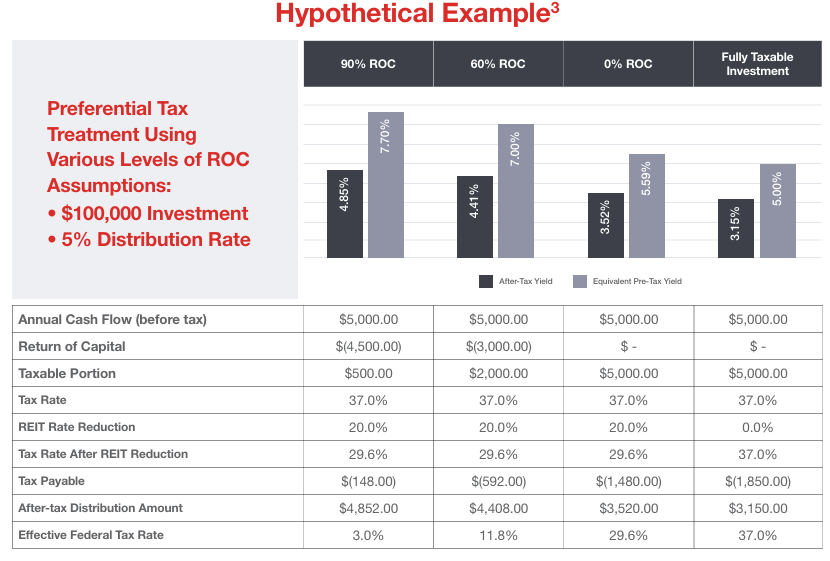
When it comes to evaluating a REIT’s benefits, investors should understand all tax advantages. Income distributions to REIT investors receive preferential tax treatment and can be compared to other investment vehicles on an aftertax yield basis. After-tax yield takes into consideration the taxes that may be due on the distribution, and can be useful when comparing fully taxable investments to tax-advantaged investments.2
Return of Capital (ROC)
Distributions benefit from real estate-related tax deductions for depreciation and amortization, reducing a REIT’s net taxable income but not reducing its cash. The ROC distributions may reduce the taxable portion of distributions by an estimated 60% to 90%.
Additional REIT Advantages
A REIT is a company that owns, operates, and/or finances a portfolio of income-generating real estate. Subject to certain suitability standards, REIT investors indirectly own part of the REIT’s professionally managed real estate portfolio.
-
Pass-through taxation: REITs are not taxed at the corporate level if at least 90% of taxable income is distributed to shareholders. Less money taxed allows for more funds available to distribute to investors.
-
Distribution taxation at favorable rates: The ordinary income portion of REIT distributions are eligible for a 20% tax deduction as part of the Tax Cuts and Jobs Act of 2017.
-
No federal and state income tax: REITs are not required to pay federal income, and in many cases, state income tax. It’s important to note that all state tax scenarios are different and investor benefits will vary from state-to-state.
-
Capital gains treatment: If a portion of a REIT’s distributions comes from long-term capital gains, they are taxed at lower rates than ordinary income. REITs can also defer capital gains taxes by executing certain tax-deferred investment strategies, such as a Section 1031 exchange.
-
Estate planning advantages: When REIT shares are inherited, heirs receive a step-up in basis to fair market value without having to pay taxes on the appreciation of the shares.
Understanding a REIT’s preferred tax treatment is particularly beneficial for investors seeking an attractive long-term investment strategy, as it highlights the value of REIT distribution rates, their tax advantages, and potential income.
The Power of Preferential Tax Treatment in REIT Investments
When it comes to evaluating the tax advantages of a real estate investment trust (REIT) investors should understand the impact of after-tax yield.
Education & Resources
1 The value of underlying REIT assets will fluctuate and may be worth less than the real estate program initially paid, and the investor may not be able to sell the investment.
2 REIT distributions cannot be guaranteed, may be modified at management’s discretion, and may be paid from sources other than cash flow from operations, including borrowing and net offering proceeds.
3 The hypothetical example and any accompanying communications have been prepared for informational purposes only, and are not intended, and should not be construed, as tax, accounting or legal advice to any potential investor. All prospective investors are strongly encouraged to consult with and rely on their own tax, legal, accounting, financial or other professionals. This model contains several assumptions about future events of a hypothetical real estate investment trust. These assumptions are arbitrary and do not correspond to any specific real estate investment trust.
This is neither an offer to sell nor a solicitation of an offer to buy any security, which can be made only by an offering memorandum or prospectus, which has been filed or registered with appropriate state and federal regulatory agencies and sold only by broker dealers and registered investment advisors authorized to do so. An offering is made only by means of the offering memorandum or prospectus in order to understand fully all of the implications and risks of the offering of securities to which it relates. A copy of the applicable offering memorandum or prospectus must be made available to you in connection with any offering.
The views expressed herein are subject to change based upon economic, real estate and other market conditions. These views should not be relied upon for investment advice. Any forward-looking statements are based on information currently available to us and are subject to a number of known and unknown risks, uncertainties and factors which may cause actual results, performance or achievements to be materially different from any future results, performance or achievements expressed or implied by these forward-looking statements.
Disclosure
Disclosure Opinions expressed reflect the current opinions of Inland Real Estate Investment Corporation (Inland Investments) as of the date appearing in the materials only and are based on Inland Investment’s opinions of the current market environment, which is subject to change. Investors, financial professionals and prospective investors should not rely solely upon the information presented when making an investment decision and should review the most recent offering materials for the applicable investment program. Certain information contained in the materials discusses general market activity, industry or sector trends, or other broadbased economic, market or political conditions and should not be construed as research or investment advice.
Important Risk Factors to Consider
Investments in real estate assets are subject to varying degrees of risk and are relatively illiquid. Several factors may adversely affect the financial condition, operating results and value of real estate assets. These factors include, but are not limited to:
• changes in national, regional and local economic conditions, such as inflation and interest rate fluctuations;
• local property supply and demand conditions;
• ability to collect rent from tenants;
• vacancies or ability to lease on favorable terms;
• increases in operating costs, including insurance premiums, utilities and real estate taxes;
• federal, state or local laws and regulations;
• changing market demographics;
• changes in availability and costs of financing;
• acts of nature, such as hurricanes, earthquakes, tornadoes or floods
• economic risks associated with a fluctuating U.S. and world economy, including those resulting from the novel coronavirus and resulting pandemic.
The Inland name and logo are registered trademarks being used under license. This material has been prepared by Inland Real Estate Investment Corporation (Inland Investments) and distributed by Inland Securities Corporation, member FINRA/SIPC, dealer manager and placement agent for programs sponsored by Inland Investments and its affiliates. Publication Date: 01/14/2024