



The market has been buzzing about the coming “QOZ 2.0” reboot, which includes new incentives, updated provisions, a revamped opportunity zone map, and a refreshed permanent framework. It’s exciting, and it’s launching in January 2027. However, what many may be overlooking is that the current QOZ framework still offers significant tax advantages and will remain fully available until December 31, 2026.
For those with capital gains from the sale of real estate, a business, securities, art, jewelry, etc., we believe this period provides an important opportunity to capture meaningful tax efficiency now versus waiting on the sidelines and potentially paying a significant tax bill. Why wait?
Complete Tax Elimination: The QOZ 1.0 Standout Tax Benefit
The current QOZ program offers two primary tax-related advantages:
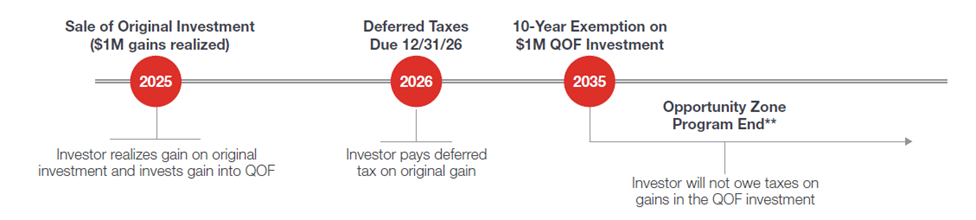
- Deferral of capital gains for a defined period (expires December 31, 2026)
- Permanent elimination of capital gains on QOZ appreciation after a 10‑year hold
While the current program’s deferral window is nearing its end, the most economically meaningful benefit has always been the potential long-term, tax‑free growth after a 10‑year hold. This advantage remains fully available today.
Most tax incentives simply reduce, delay, or offset taxes. The 10‑year rule does something different: it erases taxes on all future appreciation. That means no capital gains tax on the growth, no depreciation recapture at exit, and no tax drag compounding over time, which is a rare combination in U.S. tax law.
Waiting On the Sidelines Has a Cost
The idea that those with capital gains should hold off for QOZ 2.0 is a common misconception in our opinion. For many investors, the timing of their liquidity event and when gains are triggered often dictates the decision of the investment window more than pending legislation. By delaying a potential QOZ investment, investors may:
Lose compounding time: The 10‑year clock begins the moment capital enters a qualified opportunity fund. Every month spent waiting pushes the potential tax‑free exit further into the future, reducing the power of long‑term appreciation.
Miss potential opportunities: Much of today’s QOZ landscape centers on proven managers, stabilized strategies, and strong underlying markets. By sitting out, investors could overlook attractive deals that are available now but may not be later.
Important Considerations
Fund structure and overall portfolio construction may play a meaningful role in shaping after‑tax results.
Limited Partnership: Limited partnership qualified opportunity funds can pass through bonus depreciation and cost‑segregation benefits, often generating passive losses that may offset other passive income.
Portfolio Construction: Diversified qualified opportunity funds may provide broader geographic and asset exposure, along with more tools to mitigate market risks. Because QOZ investments require a 10‑year hold, different markets will experience shifting economic conditions. Investors should consider risk tolerance and overall portfolio design when evaluating a QOZ allocation to ensure the strategy supports long‑term objectives.
Finite‑Life Structure: Finite-life qualified opportunity funds often align all investors around the same investment and exit timeline allowing managers to make asset‑level sale decisions without creating adverse tax outcomes for different investors. This alignment reduces complexity and supports a cleaner path to the tax‑free exit that sits at the core of the opportunity zone incentive.
QOZ 1.0: Still Attractive & Strategically Smart
For those holding capital gains, we believe the current QOZ framework remains one of the most advantageous tax strategies available. The primary benefit that has driven demand for QOZs throughout the last decade, the potential for complete tax elimination by holding a QOF for 10 or more years, is still fully available. For those with a goal of tax‑efficient growth, QOZ 1.0 potentially provides the structure and incentives to contribute to building long-term wealth.