



As commercial real estate (CRE) enters what we believe is a fifth major cycle, 2026 may face a dramatically different landscape than just a few years ago. With valuations appearing to hit bottom in 2025, tightening supply, and accelerating demographic tailwinds, we see several sectors that are positioned for renewed strength.
ODCE Index (Log Scale)1
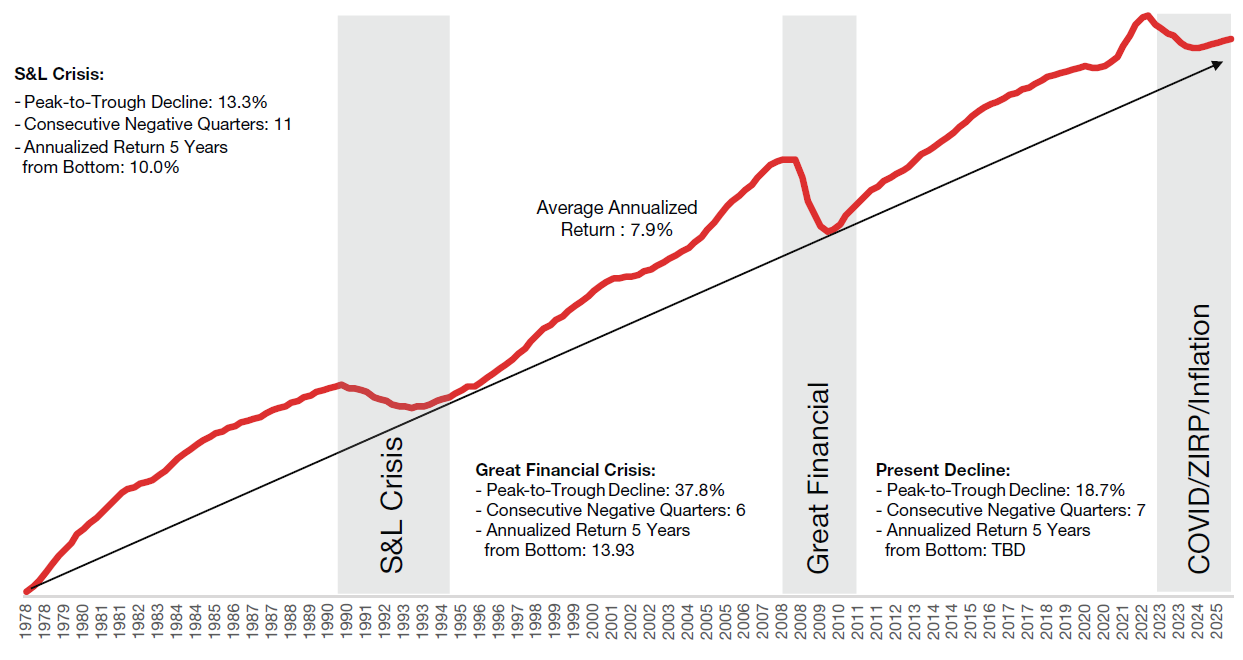
|
S&L Crisis |
GFC |
Present Decline |
|
Peak-to-Trough |
-13.3% |
-37.8% |
-18.7% |
Duration (Quarters) |
11 |
6 |
7 |
Annual Return 5 Years from Bottom |
10.0% |
13.9% |
TBD 5.3% throughout 6 Qs |
Outperformance (Over Since Inception Return) |
2.1% |
5.9% |
TBD |
Residential
The multifamily market absorbed an impressive 1.1million units, despite the historic supply wave of 2024/2025. Vacancy remains within normal ranges at 5.2%, while annual rent growth briefly turned negative (–0.7%) during this time.2 With construction starts now sharply lower, new deliveries are expected to steadily decline through 2027,3 tightening the supply–demand balance.
Outlook for 2026: Affordability pressure continues to delay household formation, lifting rental demand for traditional multifamily and build-to-rent communities. Coupled with a shrinking development pipeline, we hold the view that the stage is set for future rent growth.
Self‑Storage
Following a pandemic-fueled boom/bust period, self‑storage is entering a what we believe is a stabilization phase. Rent declines have moderated, and occupancy is normalizing as the market digests the surge of recently added supply. We think long‑term, strong demographic drivers, including downsizing, and household transitions, support the sector’s trajectory. Utilization still sits at only 12%,4 which we believe leaves ample runway for adoption.
Outlook for 2026: 2026 is expected to be the year of normalization, transitioning from negative to flat‑to‑positive rent growth.
Student Housing
Despite talk of a “demographic cliff”—or the steep decline in traditional-age students projected to start by 2026, with the number of new high-school graduates expected to fall by about 13%—demand at top universities within Power 4 conferences (ACC, Big 10, Big 12,SEC) remains exceptionally strong. These schools reject far more applicants than they admit,6 maintaining tight local housing conditions even as the national college‑age population contracts. Limited new supply and resilient enrollment provide strong performance fundamentals.
Outlook for 2026: Competitive admissions at Power 4 schools are expected to keep demand elevated, and when paired with the significant undersupply of housing near campuses, we believe the result is likely to be sustained premium rent growth, strong preleasing velocity, and consistently high occupancy at these schools.
Medical Outpatient Buildings (MOBs)
We believe healthcare trends are strongly supportive of MOB demand. With one in five Americans expected to be 65 or older by 2030,7 demand is rising sharply for procedures, diagnostics, and specialty care delivered outside traditional hospital settings. Over the past decade, hospital admissions have declined by 15%, while outpatient visits have increased by 10%.8
Outlook for 2026: Powered by an aging population, the continued shift of procedures to outpatient settings, and a persistent shortage of new supply, we expect MOBs to keep demand high, occupancy tight, and fundamentals exceptionally stable
Senior Housing
Senior housing is positioned for significant demand growth over the next decade. Baby boomers are entering the state of life that traditionally requires assisted living, memory care, and independent living options. High construction costs have constrained new supply, which we anticipate will set up a deep, long‑term supply/demand imbalance.
Outlook for 2026: With powerful demographic-driven momentum, we see senior housing as positioned for sustained occupancy strength and continued rent growth.
Retail
Years of under‑building have created structurally tight retail conditions. Occupancy is high, rents continue to climb, and grocery‑anchored and necessity‑based retail remain among the strongest performers. Absorption turned positive again in Q3 2025 with starts remaining near historic lows, supporting pricing power.
Outlook for 2026: Supported by resilient consumer spending, limited supply, and strong demand for well‑located, we believe that necessity‑oriented retail is positioned for a stable 2026.
Office
Office shows early signs of stabilization, but it remains the sector with the greatest uncertainty. Leasing activity has improved but remains below pre‑pandemic levels. Structural headwinds, including hybrid work and potential AI‑driven space efficiencies, will continue to challenge recovery efforts for the sector.
Outlook for 2026: With muted demand, elevated vacancies, and a continued flight to quality defining performance across most markets, we see the office sector facing another challenging year.
Industrial
After unprecedented pandemic-era demand, we observe the industrial sector shifting into a cooling but stable environment. Elevated supply and moderating leasing activity create short‑term pressure, but powerful long‑term demand drivers—including e‑commerce, reshoring, and supply‑chain restructuring—support sustained growth. Many facilities may see capital allocation toward AI‑driven automation, particularly in large‑scale logistics.
Outlook for 2026: Fueled by resilient e‑commerce demand, and a tight logistics supply chain, we believe industrial demand is poised for another strong year. This maybe somewhat offset by supply growth in the sector which will need to be absorbed before increased returns are seen.
Where Opportunity Lies in 2026
Across the spectrum, we hold the view that alternative real estate sectors (student housing, senior housing, self‑storage, and medical outpatient buildings) are expected to outperform, driven by demographics and life‑event–based demand. Traditional sectors offer selective opportunity, particularly where supply pipelines have fallen sharply.
With valuations bottoming and transaction activity rising, we believe 2026 offers a rare opportunity to enter the early innings of a new CRE cycle, one defined less by operational excellence, demographic momentum, and AI‑enabled productivity gains.
2 RealPage YoY Effective Rent Growth & Vacancy, Data as of November 2025
3 RealPage Annual Supply, Data as of Q3 2025
4 Yardi Data Subscription; Fred TTLHH
5 https://www.chronicle.com/special-projects/the-different-voices-of-student-success/becoming-a-student-centric-institution/what-is-the-demographic-cliff
6 Georgetown University Center on Education and the Workforce7 https://www.spglobal.com/market-intelligence/en/news-insights/articles/2024/11/1-in-5-americans-to-be-65-years-old-or-older-by-2030-86270288
8 Healthcare Realty. Investor Presentation