


Driven by a rapidly aging U.S. population and rising healthcare needs, we see senior housing sector demand reaching a critical inflection point.
In today’s economic landscape, marked by slow growth and uncertainty, investors continue seeking real estate sectors that offer favorable long-term tailwinds and consistent performance. Senior housing checks both boxes.
More Seniors, More Housing: Baby Boomers have the wealth to seek high-end housing as they age
Significant demographic shifts are expected with the continual growth of older generations. In fact, the relative share of the population 75 years and older is expected to grow nearly eight times faster than the rest of the population over the next ten years, at 4.0% annually.1 This accelerating growth of Americans aged 75-plus is a primary driver of sustained demand for senior housing over the long term.
Additionally, baby boomers control a disproportionate share of U.S. household wealth.2 As they continue to age, much of this wealth is likely to be directed toward maintaining a high quality of life, including access to exceptional living experiences within senior housing communities.
Average Growth of Population by Age Tranche as of 20243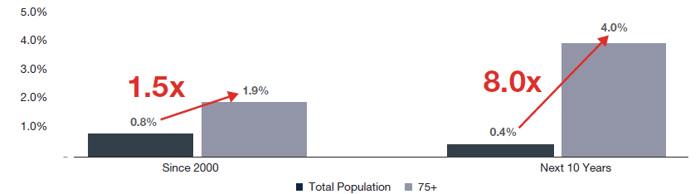
Turning Demographic Certainty into Potential Value
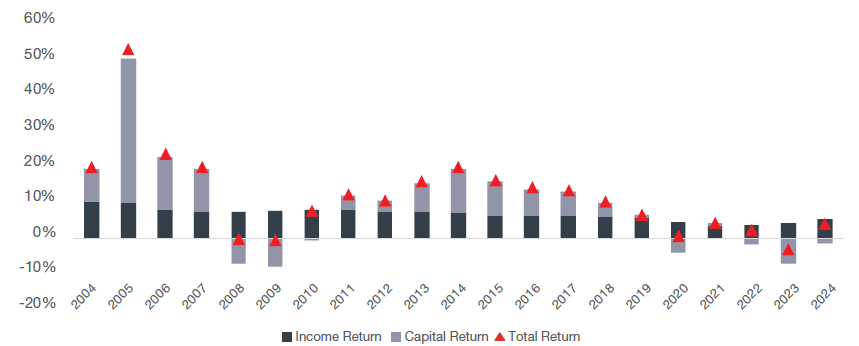
Since the 2008-2009 Global Financial Crisis, senior housing has delivered an average annual return of 7.4%,4 consistently outperforming core real estate benchmarks. Also compelling is the sector’s recovery following economic downturns, achieving an impressive 12.9% average return annually between 2010 and 2015.4 While past performance is not a guarantee of future results, these average annual returns reflect a foundation built on strong demographic-driven demand, stable lease structures, and reliable rent growth.
Senior Housing Average Returns4
Limited Supply Points to Favorable Future Demand
Looking ahead, senior housing supply is expected to fall well short of demand. The National Investment Center (NIC) projects that 800,000 new units will be required by 2030 to maintain 90% occupancy, yet only 200,000 are currently in progress.5 This shortfall of 600,000 units is further complicated by construction costs, which have increased 42% since 2020, and limited new development in most major markets.5,6
Senior housing presents a rare moment of clarity in today’s uncertain landscape, offering substantial opportunity for qualified operators who prioritize a high-level of care, functional design, and resident experience. In a fragmented market, this opportunity allows experienced providers to differentiate themselves and benefit from competitive separation.
The evolution of the senior housing sector represents more than a demographic shift—it’s a strategic opportunity shaped by the aging U.S. population and rising healthcare needs. As stability becomes increasingly valuable, senior housing stands out not just for its resilience but for its demographic inevitability, which has the potential to generate compelling results throughout the sector.
Sources:
1 S&P Global. 1 in 5 Americans to be 65 years old or older by 2030. Nov 2024.
2 Federal Reserve – Distribution of Household Wealth in the U.S. Since 1989
3 FRED – GDP & Center for Medicare & Medicaid Services NHE Historical and Projections Data
4 NCREIF Subscription Data
5 NIC Map Data(R) powered by NIC MAP Vision
6 Weitz. Senior Living Construction Costs Brief Winter 2024. February 2024