


Demand for medical outpatient buildings (MOBs) continues to accelerate, driven by an aging U.S. population, and a growing shift from inpatient to outpatient care settings.
No matter the economic climate, people will continue to need to see a doctor for routine visits or surgical procedures – highlighting the sector’s strength, resilience, and attractiveness as a commercial real estate strategy.
Shift to Outpatient Care
MOBs are well-positioned to capture and sustain future demand resulting from, among other things, advancements in medical technology, particularly minimally invasive techniques, along with changing patient preferences for greater convenience and accessibility. Medical innovations have enabled many procedures to move from inpatient to outpatient settings with 59 medical procedures approved for outpatient migration between 2018 and 2023.1 Moreover, hospital admissions have declined by 15% since 2000, while outpatient visits have increased by 10%.2 The trend toward outpatient care was further underscored during the COVID-19 pandemic as hospitals were strained by an influx of patients needing care for complications arising from the virus.
Inpatient vs Outpatient Visits (Indexed to 1999 - Per 1,000)2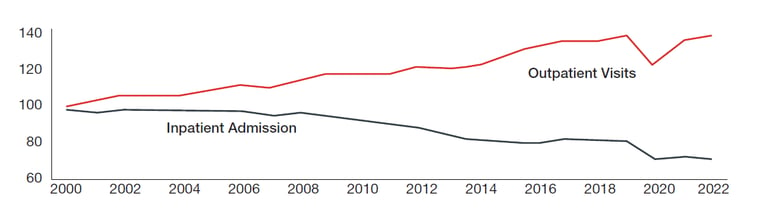
Demand for Healthcare Increases with Age
Currently the U.S. population sits at approximately 337 million and is projected to add nearly 32 million over the next 25 years.3 This expected annual growth of approximately 0.4% annually will also bring with it drastic changes to the composition of the population, as millions will be added to the 65-plus population, and the 80-plus cohort will grow at 4.7% annually.3 As Americans age, complex health needs and chronic conditions tend to increase, leading to more visits to specialists like geriatricians and orthopedic doctors. On average, Americans aged 65-plus typically have seven doctors’ visits a year.4
Annual Physician Office Visits4
| AGE | NUMBER OF VISITS |
| < 45 | 2 |
| 45 - 64 | 4 |
| 65+ | 7 |
Strong Fundamentals: Occupancy | Rents | Construction
MOB fundamentals continue to be healthy amid macroeconomic headwinds. With the high cost of building a ground-up medical outpatient space and expensive, cumbersome equipment such as X-Ray machines, MRI machines, and exam tables, most MOB tenants tend to remain in the same space for a long period of time, leading to increased occupancy and rental rates.
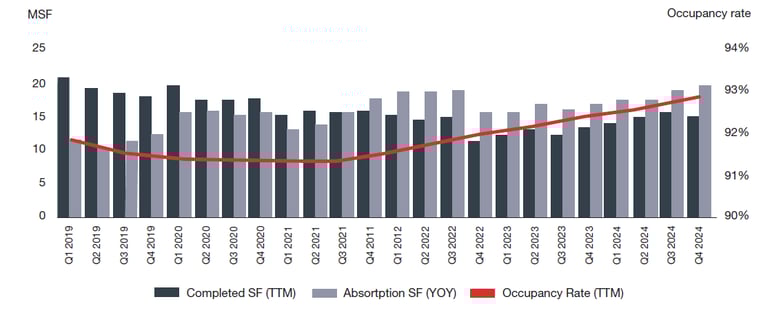
Occupancy rates particularly for specialty providers (i.e., dermatologists, psychiatrists, ophthalmologists, orthopedics, gastroenterologists, and OBGYNs) is holding steady at 93%, up from the low of 91% seen during the pandemic.5 And over the last 14 quarters, absorption has outpaced new supply. Rising demand and limited premium medical outpatient space have led MOB rental rates to achieve their high point near $25 per square foot in Q4 2024.6
Supply vs Demand6
OBBBA Impact on MOBs
According to PwC, The One Big Beautiful Bill Act (OBBBA) is projected to reduce federal healthcare spending by approximately $1 trillion through 2034 by implementing additional eligibility rules on government health plans, expanding administrative procedures around enrollment, modifying how states can obtain federal funding for Medicaid, and not extending ACA premium subsidies. These changes, coupled with other potential changes that reflect a net defunding to healthcare agencies (i.e. 25% funding reduction for HHS in the FY 2026 proposed budget), have the potential to accelerate a long-term transformation of the health system.7 While the bill may shift how care is delivered and funded, the fundamental demand for medical care, and the need for it to be delivered, will continue to be very strong due to the demographic realities we’ve highlighted. We expect robust demand for MOB as a result.
Fueled by demographic and societal trends, which are less tethered to broader market dynamics, MOBs are likely to remain an attractive real estate sector in the coming decades. The sector is uniquely positioned for sustained growth due to an aging U.S. population that requires more specialized healthcare services and a meaningful shift to outpatient care vs a traditional inpatient setting. Coupled with historically strong fundamentals—such as favorable long-term lease structures, and a pronounced supply/demand imbalance— we believe MOBs will potentially outperform other sectors in the longer term.
Sources:
1 CBRE – 2025 U.S. Healthcare Real Estate Outlook
2 Nuveen. Medical outpatient buildings are well-positioned to outperform. August 2024
3 Worldbank.org – Population Estimates and Projections – 2024
4 Healthcare Realty – Investor Presentation
5 Globe St. Medical Outpatient Occupancy Reaches 92.8% Amid Aging Population, Spending Surge. January 2025; HREI. Thought Leaders: U.S. medical office occupancy remains steady at 91.5% throughout the COVID crisis. October 2020 )
6 JLL. 2025 Medical Outpatient Building Perspective
7 https://www.pwc.com/us/en/industries/health-industries/library/impact-of-obbba-on-us-health-system.html