



Many may have noticed an interesting trend over the past several months that we believe will impact the way some allocate investment portfolios. Business development companies (BDCs) and parts of the private credit market have started to decline – in some cases, meaningfully – and we see alternative real estate stepping into the spotlight as the next frontier.
BDCs have experienced significant pressure recently, with some leading companies dropping 15-20% in 2025, fueled by falling interest rates, tighter spreads and rising credit risks.1
5 Largest Externally Managed BDCs1
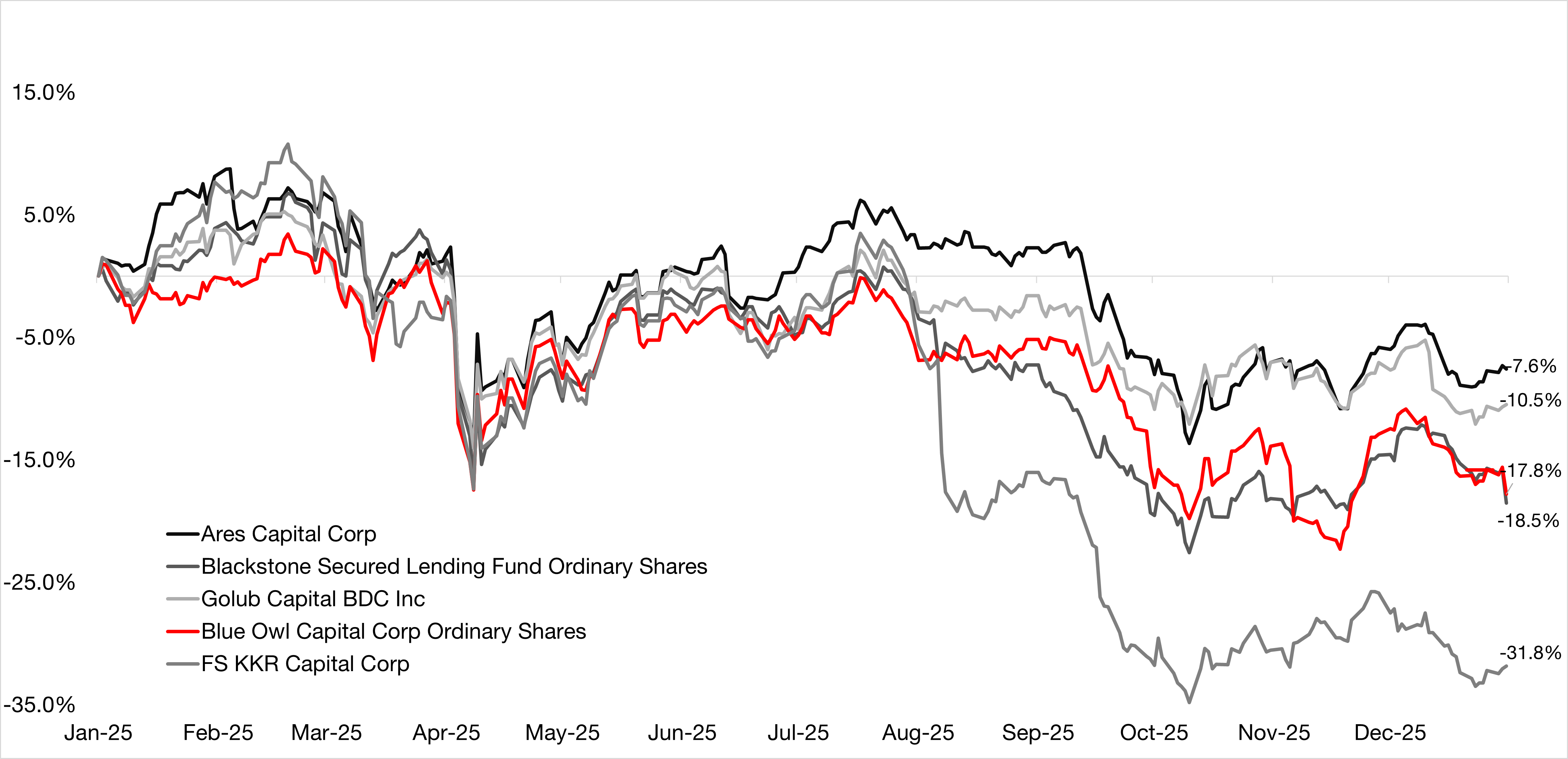
Given these latest moves, we believe it might be worth reassessing investment allocations. Let’s break down what we see happening.
BDCs and Private Credit Are Showing Signs of Weakness and What That Means
BDCs give public‑market investors access to private credit–style loans, with liquidity and transparency that private funds don’t offer. BDCs have become an attractive strategy for those seeking high yields and perceived stability. A sharp increase, however, often brings structural pressure, and we believe several indicators now suggest that parts of the private credit market are entering a more challenging phase.
Key factors we see leading to strain:
- Delayed borrower payments are resulting in inconsistent income, impacting dividend coverage2
- A rise in non‑accrual loans by lenders because borrowers are missing payments3
- Higher leverage at both the borrower and fund level
- Tougher refinancing conditions as existing debt matures in a higher interest rate environment
- Valuation declines within certain BDC portfolios due to tightening spreads,
sector-specific weaknesses, lower EBITDA, etc.4
These developments aren’t isolated. Together, we see them pointing to a private credit market that may be reaching a challenging phase of the cycle.
To be clear, this isn’t about predicting doom. A decline in one part of a portfolio doesn’t mean the entire portfolio is a bust. It’s about recognizing signals, understanding what it means for the cycle, and responding thoughtfully – often suggesting a need to rebalance allocations.
Alternative Real Estate Takes the Stage
We hold the view that commercial real estate is looking refreshed while private credit looks stretched. Many alternative real estate sectors (self‑storage, medical outpatient buildings, senior housing, single‑family rentals, student housing, and others) are showing signs of early‑cycle recovery, after several years of repricing, volatility, and uncertainty.
Key factors we see leading to real estate recovery:
- Stabilizing fundamentals
- Valuations have reset to more attractive levels
- Demand is improving in key sectors
- Investor interest is steadily returning
Historically, these inflection points have created meaningful opportunities for those with a long-term investment horizon. This potential is evident as the National Council of Real Estate Investment Fiduciaries (NCREIF) Property Index (NPI)* and the ODCE Index* both incorporate a broader range of alternative property types, while institutions continue increasing allocations to these sectors,5 underscoring the meaningful role commercial real estate plays in a balanced, long‑term portfolio.
*NCREIF’s Property Index is the organization’s flagship benchmark; The NCREIF ODCE Index is its index of the 25 largest core funds.
Given the current state of private credit and BDCs, we believe it might be worth reassessing portfolio allocations. Concentration in any single strategy can leave a portfolio exposed to risk, especially when a strategy begins to struggle. Alternative real estate may offer a different set of return drivers, more attractive entry points, and the potential to benefit from an early-stage recovery cycle we see already taking shape across several property sectors.
By building a balanced and resilient portfolio—one designed to face shifting cycles and capture opportunities where fundamentals are strengthening, valuations are attractive, and long‑term demand remains solid—we trust that there’s a better chance of navigating uncertainty. In today’s market, alternative real estate stands out to us as one of those areas worth a closer look.
2 https://www.fitchratings.com/research/corporate-finance/us-bdcs-face-lower-earnings-dividend-coverage-elevated-pik-in-2026-19-11-2025
3 https://www.fitchratings.com/research/corporate-finance/tight-spreads-rising-non-accruals-to-further-weaken-bdc-earnings-28-03-2025
4 https://www.fitchratings.com/research/corporate-finance/us-bdcs-face-lower-earnings-dividend-coverage-elevated-pik-in-2026-19-11-2025
5 https://urbanland.uli.org/capital-markets/investors-fueling-growth-in-alternative-property-sectors